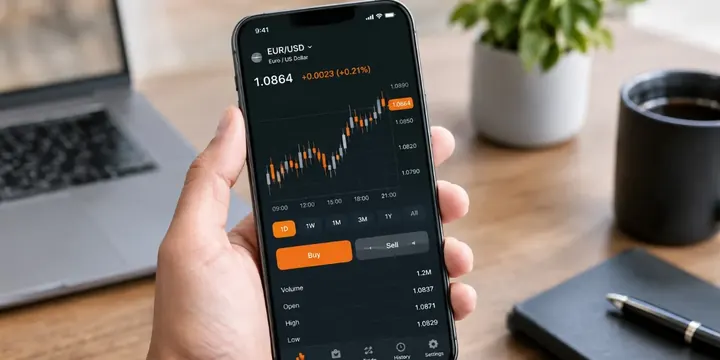
The gist
- A currency pair is a price of one currency in another; buying the pair means buying the first and paying with the second.
- Moves are small, so they are measured in pips and traded in lots, usually with leverage that regulators cap for retail clients.
- Spread, commission and overnight financing are charged whether the trade wins or loses, which matters most to anyone holding for weeks.
How forex trading works is easier to grasp by following one trade than by memorising definitions. Below we take an illustrative position in GBP/USD from the first quote to the moment it is closed, stopping at each step to explain what is going on and what it costs. Along the way you will meet pips, lots, leverage, margin and the overnight charge that catches out anyone who holds a position for longer than a day.
Step one: reading the quote
A currency pair is simply the price of one currency expressed in another. GBP/USD 1.2700 means one British pound costs 1.2700 US dollars. The first currency is the base; the second is the quote currency, the one the price is written in.
Your broker actually shows two prices, for example 1.2699 and 1.2701. Sell and you get the lower figure, called the bid; buy and you pay the higher one, the ask. That gap is the spread, a cost you meet on every single trade: buy and instantly sell, and it is gone.
Buying GBP/USD, also called going long, is a bet that the pound will strengthen against the dollar. Selling, or going short, is the opposite. In the retail market you can do either with equal ease, because you are trading a contract that tracks the rate, not swapping banknotes.

Step two: pips and lots
Major exchange rates rarely move more than a percent or so in a day, so prices are quoted to four decimal places and the standard unit of movement is the pip: 0.0001 for most pairs and 0.01 for pairs quoted in Japanese yen. Many brokers show a fifth decimal, a tenth of a pip, sometimes called a pipette or point.
Trades are sized in lots: a standard lot equals 100,000 units of the base currency, with mini (10,000) and micro (1,000) lots for smaller positions. When the dollar is the second currency in the pair, each pip on a standard lot comes to $10; with any other quote currency, the dollar figure shifts as rates move. On USD/JPY at an illustrative 150.00, one pip on a standard lot is 1,000 yen, or about $6.67. The pip value calculator handles every combination.
Step three: leverage and margin
Because the moves are small, retail currency trading is normally leveraged. You put down a deposit, called margin, and the broker lets you control a much larger position. Regulators cap how far this can go for retail clients: 30:1 on major pairs in the UK, the EU and Australia, 20:1 on other pairs there, and 50:1 on majors in the United States.
In our illustrative trade we buy 0.5 lots of GBP/USD at 1.2700. That is 50,000 pounds, worth 50,000 × 1.2700 = $63,500. At 30:1 the broker requires margin of $63,500 ÷ 30, about $2,116.67. The rest of the exposure is, in effect, borrowed. The margin calculator will do this sum for any pair and leverage.
Margin is not a fee. It is money set aside while the position is open. But if losses eat into your account, the broker will warn you and then start closing positions. Under UK and EU rules, retail positions are closed out when your equity falls to 50% of the margin required, and negative balance protection stops your balance going below zero.

Step four: risk before reward
Experienced traders decide where they are wrong before they decide how much they might make. In our example we place a stop-loss order at 1.2660, 40 pips below the entry. On 0.5 lots each pip is worth $5, so if the stop is hit the loss is 40 × $5 = $200, plus costs. We also set a target at 1.2780, 80 pips above entry, which would be worth 80 × $5 = $400 before costs.
Working the other way round is more useful: decide how much of your account you are willing to lose on one idea, then let the stop distance determine the size. The lot size calculator does exactly that.
| Illustrative trade | Value |
|---|---|
| Buy 0.5 lots GBP/USD at | 1.2700 |
| Position value | $63,500 |
| Margin at 30:1 | $2,116.67 |
| Pip value (0.5 lots) | $5 |
| Stop-loss at 1.2660 (40 pips) | −$200 before costs |
| Target at 1.2780 (80 pips) | +$400 before costs |
Step five: the overnight charge
Here is where how forex trading works diverges most from buying an index fund. A retail currency position is rolled forward every evening at 17:00 New York time. When it rolls, your broker credits or debits a financing amount, usually called the swap or rollover. It reflects the difference in interest rates between the two currencies, plus the broker's own mark-up. On most positions most of the time, after the mark-up, it is a charge.
Many brokers apply three days' worth on one night of the week, usually Wednesday, to cover the weekend. A charge of a few dollars a night looks harmless on a trade held for an afternoon. Held for months, it can outweigh the spread many times over. Anyone with a long horizon should look up the swap rates before opening a position, and our guide to trading fees shows how to add them up.
What moves exchange rates
Over short periods currencies react to surprises: an inflation figure that comes in higher than expected, a central bank that changes its tone, a political shock. Over longer periods three forces tend to matter:
- Interest rates. When investors expect a central bank to keep rates high, capital tends to flow toward that currency; hence the attention paid to every rate decision.
- Growth and trade. Economies that grow faster or export more tend to see steady demand for their currency.
- Risk appetite. In periods of stress, money has historically moved toward the US dollar, the Japanese yen and the Swiss franc.
None of this makes rates predictable. Professional forecasters with vast resources are regularly wrong, and short-term moves are dominated by noise.
When the market trades
The currency market opens on Sunday at 17:00 New York time, as the business week begins in New Zealand and Australia, and runs without a break until Friday at 17:00. Activity follows the clock: the Asian session, then London, then New York. The overlap between London and New York is usually the busiest period, with the tightest spreads. Spreads tend to widen around the daily rollover and in the quiet hours before Asia opens. The market board on our homepage shows what is open now.
Is currency trading a long-term investment?
For most people, no, and it is worth being clear about why. A share is a claim on a business that can grow its earnings. A currency pair is a relative price between two moneys; over long periods neither side systematically "grows". Leveraged positions also carry that daily financing cost. Long-term investors usually meet currencies indirectly, through the exchange-rate effect on overseas shares and funds they own, rather than by trading pairs.
If you do trade, treat any forex website that promises steady monthly returns, a secret system or a guaranteed win rate as a warning sign rather than a resource. That includes content that looks educational but ends with an account-opening button.
Reader questions
What is the smallest amount I could trade forex with?
Brokers set their own minimums, and micro lots make small positions possible. The more useful question is how much you can afford to lose entirely, because leverage means a small deposit can still be wiped out quickly.
What is the difference between a pip and a point?
A pip is the fourth decimal place on most pairs (the second on yen pairs). Many platforms quote a fifth decimal and call each step a point, so ten points make one pip. Check which one a broker uses when it quotes spreads.
Why did my position lose money overnight when the price did not move?
Most likely the overnight financing charge, or swap, applied at the 17:00 New York rollover. It is charged or credited on positions held past that time, and some brokers apply a triple charge on one night each week.
Sources
- European Securities and Markets Authority, CFD product intervention measures
- UK Financial Conduct Authority, CFD rules for retail clients
- US Commodity Futures Trading Commission and National Futures Association, retail forex leverage limits